
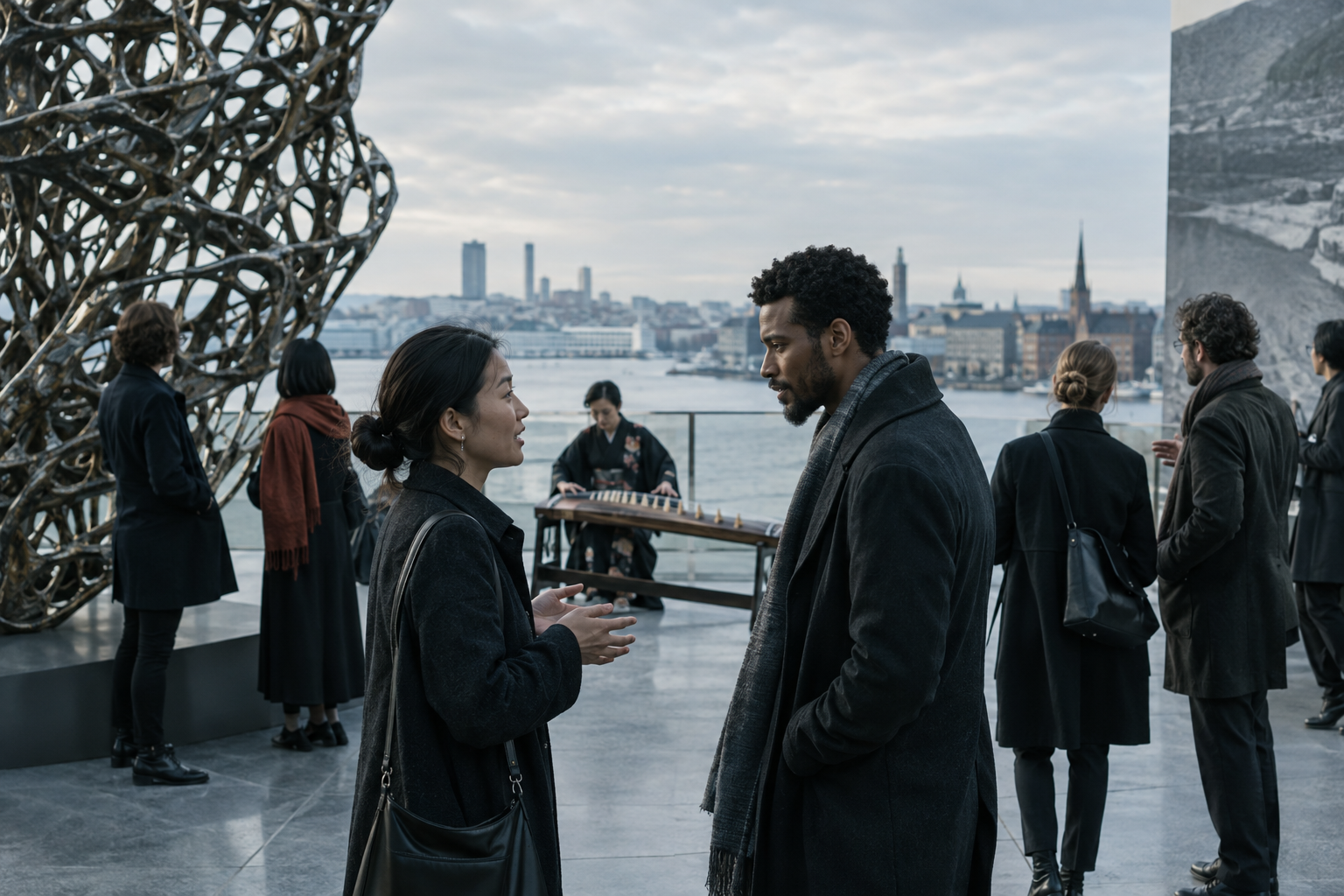
Cultural diplomacy uses art, heritage, language, and shared creative experience to build relationships across borders. It can take the form of an artist residency, touring exhibition, publishing programme, festival partnership, public artwork, or long-term institutional exchange.
At its best, cultural diplomacy creates room for encounter where formal politics cannot. It helps people understand different histories, test ideas, and form relationships that may outlast a single project. At its weakest, it treats culture as decoration for a political or commercial agenda.
The difference lies in strategy, governance, and the quality of the exchange.
What is cultural diplomacy?
Cultural diplomacy is the use of cultural activity to develop international understanding and relationships. Governments have long supported it through museums, cultural institutes, educational exchanges, and bilateral programmes. Today, the field also includes cities, universities, foundations, creative businesses, grassroots organisations, and individual artists.
This wider landscape matters. Cultural relationships are rarely produced by governments alone. They emerge through repeated contact among curators, producers, educators, audiences, and communities. A collaboration between two small arts organisations may have modest visibility yet create deeper trust than a high-profile showcase.
Cultural diplomacy is often grouped with soft power, but the terms are not interchangeable. Soft power describes the ability to attract or influence through values and culture. Cultural diplomacy should be more reciprocal. It works through dialogue, exchange, and sustained participation rather than one-way promotion.
Soft power and cultural influence
Soft power is a country’s ability to influence others and shape international outcomes through attraction, persuasion, and cultural appeal rather than military force, economic coercion, or direct payment. Political scientist Joseph Nye coined the term in the late 1980s. In simple terms, soft power works by making other countries and publics more inclined to want compatible outcomes.
According to Nye’s framework, a nation’s soft power rests on three principal resources:
- Culture: Art, music, film, literature, cuisine, fashion, sport, and heritage that resonate internationally. Hollywood, K-pop, the British Premier League, and international art biennials all shape perceptions beyond their immediate fields.
- Political values: Domestic ideals and systems, including democracy, human rights, innovation, and social openness, when a country is seen to uphold them consistently at home and abroad.
- Foreign policies: Diplomacy, humanitarian aid, climate leadership, and multilateral cooperation when these actions are regarded as legitimate and mutually beneficial.
Culture can attract attention, but attraction alone does not guarantee trust. A country’s cultural reach may be weakened when its policies contradict the values it promotes. Soft power therefore depends on credibility and conduct as much as visibility.
Soft power, hard power, and smart power
| Dimension | Soft power | Hard power |
| --- | --- | --- |
| Mechanism | Attraction, persuasion, and agenda-setting | Coercion, sanctions, military force, and financial leverage |
| Key tools | Cultural exchange, education, tourism, art, and diplomacy | Armed force, embargoes, tariffs, and conditional aid |
| Timescale | Long-term trust and reputational capital | Immediate compliance or deterrence |
Combining attraction with economic or security instruments is often called smart power. For example, a government may pair investment in a region with education, cultural exchange, and institutional partnerships. The relevant question for cultural organisations is whether the cultural programme retains integrity or simply becomes a softer vehicle for predetermined policy goals.
How soft power applies to cultural work
Governments fund residencies, exhibitions, exchanges, festivals, and tourism campaigns partly because culture can shape international perception. These programmes may serve several connected aims:
- Humanising a nation: Artist residencies and cultural exchanges can replace abstract political headlines with personal relationships, situated knowledge, and creative collaboration.
- Supporting nation-branding and tourism: Cultural tourism can present a destination as a centre for creativity, design, or heritage, supporting visitor economies and foreign investment. This work is strongest when it reflects local cultural life rather than manufacturing a simplified image of place.
- Working through trusted non-state messengers: Audiences may distrust direct government communications. Independent artists, curators, producers, agencies, and cultural leaders can build credible relationships across sectors and borders. Their value depends on genuine editorial and artistic independence.
This creates both opportunity and responsibility. Cultural practitioners can help ministries, cities, tourism bodies, and international partners develop more credible programmes. They should not be expected to conceal policy tensions or deliver uncritical national promotion.
For Art Account, this is where strategy, services, and systems meet. We can help partners:
- define the cultural and diplomatic purpose of a residency, exchange, exhibition, or tourism programme;
- map stakeholders across government, culture, education, tourism, business, and community networks;
- design reciprocal partnerships, governance structures, commissioning processes, and artist support;
- frame proposals around cultural value, relationship-building, reputational outcomes, and public benefit;
- develop soft-power metrics without reducing cultural work to publicity figures;
- build practical systems for delivery, documentation, learning, and long-term evaluation.
A persuasive pitch to a ministry of culture, foreign affairs department, city, or tourism authority should connect public objectives with credible cultural methods. It should explain not only what will be presented, but whose relationships will change, how local partners will hold authority, what artists need to work well, and how value will be assessed over time.
Why cultural diplomacy matters now
International relations are increasingly shaped by political fragmentation, migration, digital communication, and contested histories. Cultural work cannot resolve these forces by itself, but it can provide ways to engage with them.
Artistic exchange makes complexity tangible. A film, performance, exhibition, or public programme can hold several perspectives without forcing immediate consensus. This is especially valuable when official language has become rigid or trust is low.
Cultural diplomacy also supports the creative economy. International cultural partnerships can open professional networks, develop artistic practice, increase access to markets, and strengthen institutions. For cities and regions, they can connect local cultural capacity to global conversations without reducing place to a tourism campaign.
The strongest programmes recognise both dimensions: relationship-building and practical opportunity. They create public value while improving the conditions in which artists and cultural organisations work.
From cultural export to genuine exchange
A common mistake is to define success as visibility abroad. Sending a nationally recognised exhibition or performance overseas may generate attention, but presentation alone does not constitute exchange.
Genuine cultural exchange changes every participant. It gives local partners meaningful authority, provides artists with time to research, and allows audiences to shape the programme. It also acknowledges that knowledge moves in more than one direction.
This requires an early shift in planning. Instead of asking, “What do we want to show?”, partners can ask:
- What shared question are we exploring?
- Who should define the programme?
- What knowledge already exists in each place?
- How will artists and communities benefit?
- What can continue after the public event ends?
These questions move a project away from representation and towards reciprocity.
Principles for an effective cultural diplomacy strategy
A credible cultural diplomacy strategy begins with a clear purpose. Broad ambitions such as “building bridges” are difficult to translate into decisions. A useful purpose identifies the relationships, issues, places, and participants involved.
Long-term commitment is equally important. Trust develops through repeated activity, transparent communication, and the ability to address disagreement. Multi-year partnerships usually produce more value than isolated cultural missions, particularly when they include peer learning and reciprocal visits.
Local knowledge should shape the work from the beginning. Cultural contexts are specific, and assumptions travel badly. Local producers, artists, researchers, and community organisations can identify relevant histories, political sensitivities, practical constraints, and overlooked opportunities.
Fairness must be designed into the programme. This includes appropriate artist fees, accessible participation, realistic schedules, visa support, translation, insurance, and clarity around intellectual property. Reciprocity is not only a curatorial principle. It is an operational one.
Finally, partners need room for uncertainty. International cultural partnerships involve different working methods and institutional expectations. A strong framework sets responsibilities and boundaries without predetermining every creative outcome.
The role of artists and cultural organisations
Artists are not neutral messengers for a country, city, or sponsor. Their value often lies in questioning official narratives, revealing contradictions, and making unfamiliar experiences legible. Cultural diplomacy programmes should protect this independence rather than commission artists to illustrate a predetermined message.
Cultural organisations act as intermediaries. They hold relationships, interpret context, manage risk, and connect public objectives with artistic practice. Their institutional knowledge is essential, but it is frequently underfunded because budgets prioritise visible outputs over research, care, and administration.
Supporting these roles means funding the full process. Time for listening, development, translation, documentation, and reflection should be treated as core programme costs. Without that infrastructure, international cultural exchange becomes extractive even when its stated intentions are positive.
Risks, ethics, and accountability
Cultural diplomacy is never separate from power. Funding sources, visa regimes, colonial histories, censorship, and unequal access all affect who can participate and under what conditions.
Partners should examine whether a programme reinforces national branding at the expense of artistic freedom. They should also consider whose culture is being represented, who has authority to speak, and whether dissenting perspectives are included.
There are practical risks too. International projects can expose artists to political pressure, online harassment, legal restrictions, or personal danger. Risk assessment should therefore extend beyond logistics and reputation. It should consider participant safety, informed consent, data protection, and the consequences of public visibility.
Accountability requires clear governance. Agreements should define decision-making, conflict resolution, credit, ownership, and safeguarding. An ethical cultural partnership does not avoid tension. It creates structures for addressing it.
Measuring cultural impact and soft power
Audience numbers and media coverage can indicate reach, but they reveal little about the quality of a relationship. Cultural impact measurement should reflect the purpose and timescale of the programme.
Useful measures may include new commissions, continued collaborations, artist income, skills developed, institutional policy changes, audience learning, or access to new professional networks. Qualitative evidence such as interviews, participant journals, and peer reflection can document changes that standard metrics miss.
For programmes with explicit soft-power objectives, evaluation might also examine:
- changes in awareness, trust, or perception among specific audiences;
- the diversity and durability of international relationships;
- repeat participation or reciprocal invitations;
- new institutional, educational, tourism, or trade connections;
- the reach and credibility of independent cultural messengers;
- whether local partners gained authority, resources, and professional opportunity.
Evaluation should begin during programme design. Partners can establish a baseline, agree what meaningful change would look like, and review progress at several points. Some outcomes will only appear later, so follow-up six or twelve months after a project can be more informative than an immediate report.
The aim is not to claim that culture caused every positive development or to convert every relationship into a reputational asset. It is to understand the contribution a programme made and improve future work.
Building cultural relationships that last
Effective cultural diplomacy is patient, specific, and reciprocal. It values the relationship as much as the public output and treats artists as independent practitioners rather than instruments of influence.
For institutions, cities, brands, and civic partners, the task is to build the right conditions: shared purpose, fair resources, local authority, responsible governance, and time. For artists and cultural organisations, international exchange can expand practice and opportunity when those conditions are real.
Culture cannot substitute for policy. It can, however, create forms of contact that policy often struggles to produce. When cultural diplomacy is approached as a long-term practice rather than a promotional campaign, it becomes a durable part of how places and people understand one another.