
BraandScience is an Art Account initiative for artists, cultural organizations, businesses, brands, and civic partners seeking greater clarity about branding and what it takes to build a recognizable, meaningful, and lasting identity.
Developed by Art Account founder Kaya Gordon, the method draws on years of experience across hospitality, publishing, business development, nonprofit work, design, entertainment, and art. Across these fields, Gordon observed that branding was often presented either as a cosmetic exercise or as an unnecessarily abstract discipline. BraandScience was created to make its essential concepts more legible, from foundational principles to the small nuances that shape how a brand is understood over time.
Branding is often reduced to a logo, typeface, website refresh, campaign, or consistent social feed. Those elements can matter, but they are not the foundation. A useful brand begins with clarity about identity, purpose, position, audience, relationships, and ambition.
BraandScience approaches branding as a strategic and organizational process. The aim is not to manufacture a persona or make every organization look the same. It is to identify what is already meaningful, then translate that meaning into language, identity, communications, experiences, and practical systems.
What is BraandScience?
BraandScience is a framework for developing a public identity with greater intention. It connects purpose and practice with positioning, narrative, audience, presentation, influence, and legacy.
The name reflects the balance at the centre of the initiative. A strong brand requires both interpretation and evidence. It involves subjective questions about meaning, voice, values, and ambition, alongside practical questions about visibility, consistency, audience behaviour, operations, and long-term goals.
Instead of starting with visual trends, BraandScience starts with the underlying work: what a person or organization does, why it matters, how it relates to a wider context, who it serves, and where it intends to go.
From there, strategy can become a working system rather than a static document.
The BraandScience Periodic Table
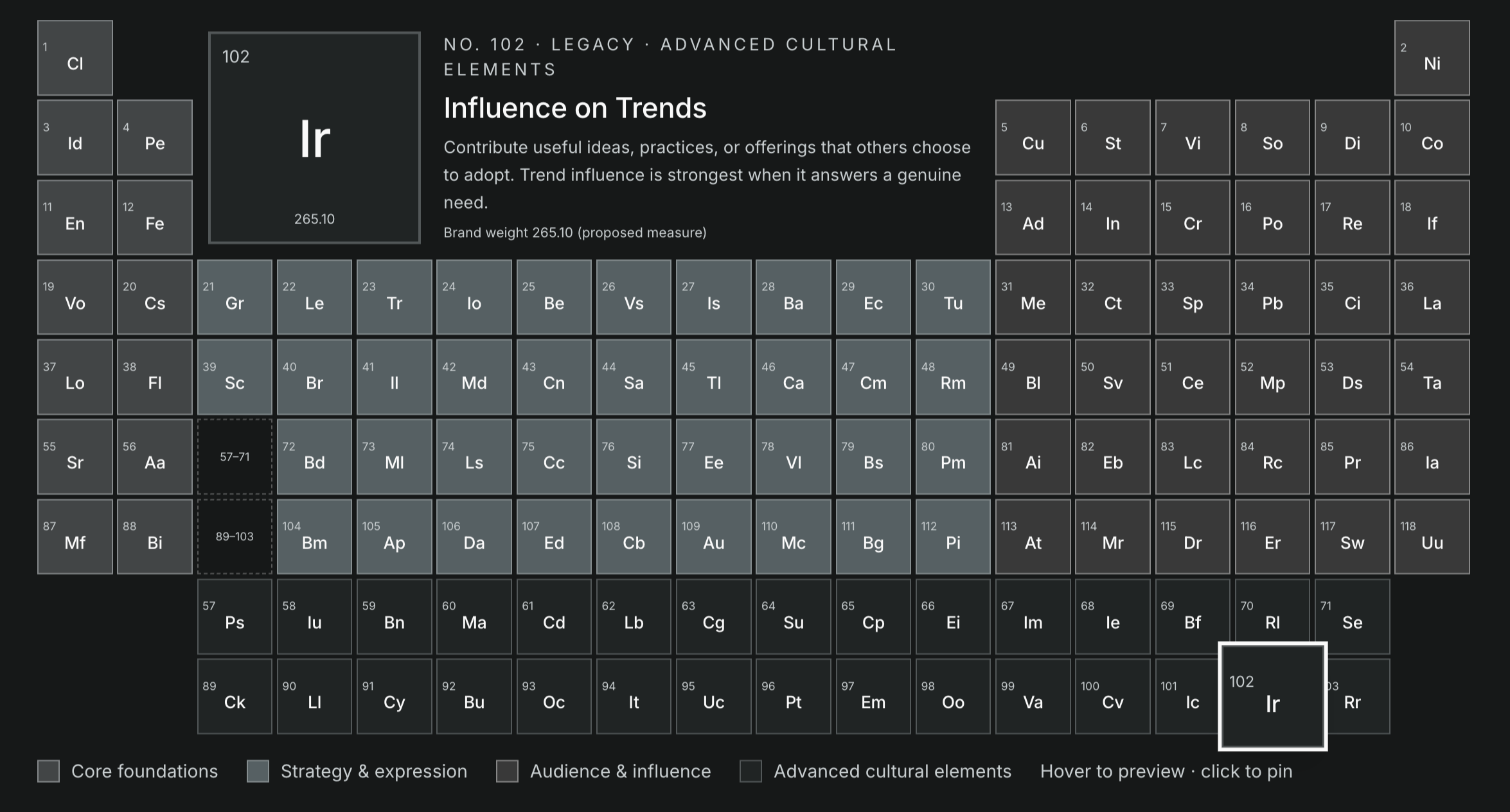
The Brand Science Method uses the structure of the periodic table as a model for understanding brand development. Just as the scientific periodic table organizes the building blocks of matter, the BraandScience Periodic Table organizes the building blocks of a brand.
It contains 118 brand elements arranged across 7 rows and 18 columns. Each element represents an ingredient in building a recognizable, meaningful, and lasting brand. Together, the structure makes a broad and sometimes fragmented discipline easier to examine, discuss, and apply.
Atomic number: the brand-building sequence
Each element receives an atomic number from 1 to 118. The number identifies its place in the framework, moving from foundational elements such as clarity and identity toward advanced elements including cultural influence, legacy, and iconic status.
A higher number represents a later stage in the sequence, not necessarily greater importance. Early elements remain essential because advanced brand outcomes depend on the strength of the foundation beneath them.
Rows: stages of brand development
The seven rows represent the progression of brand development. They map a broader journey from establishing a foundation to building recognition, influence, and long-term cultural significance.
This progression helps partners assess where a brand currently stands and what may require attention next. Development is not always linear, however. A mature organization may need to revisit its purpose, while a new initiative may already hold strong cultural relevance but lack the systems required to sustain it.
Columns: categories of brand science
The 18 columns group related brand-building concepts. They show how individual elements work together across areas including identity, strategy, communication, audience relationships, influence, and legacy.
The columns make relationships visible. A challenge that first appears to be visual, for example, may be connected to unclear positioning or inconsistent language. An audience problem may reflect a gap in experience, access, trust, or communication rather than a need for greater exposure.
Atomic mass: the weight of a brand element
In the scientific periodic table, atomic mass reflects the mass of an atom. Within the Brand Science Method, an equivalent measure could represent the weight, complexity, or cumulative impact of a brand element.
Unlike atomic number, this would be a proposed branding measure rather than a scientific property. Its purpose would be diagnostic: to consider how heavily a specific element influences a brand in a particular context. The same element may carry different weight for an independent artist, a hospitality business, a nonprofit institution, or a civic initiative.
The central idea is straightforward: the atomic number identifies each element, the rows map the broader journey, and the columns reveal relationships between related brand concepts.
Why brands need strategy
Every artist, organization, business, and initiative has a brand, whether it actively manages one or not. Each exhibition, service, product, publication, partnership, event, interview, customer interaction, and digital post contributes to how it is understood.
Without a clear brand strategy, these signals can become fragmented. The work may be strong, but the language around it may be vague. A portfolio or program may show range without revealing direction. Different departments, platforms, or partners may present conflicting versions of the same identity.
This fragmentation creates unnecessary friction. Audiences, clients, collaborators, commissioners, funders, customers, and members of the public often encounter a brand through limited information. Clear positioning helps them understand what they are seeing, why it matters, and how they can participate.
Brand strategy does not replace the quality of the underlying work. It creates the conditions for that quality to be recognized, remembered, trusted, and connected to relevant opportunities.
Branding without reducing the work
Resistance to branding is often valid. Conventional branding can reward simplification, repetition, and easy categorization. Creative practices, cultural organizations, community initiatives, and evolving businesses may depend on complexity, development, contradiction, and change.
The answer is not to avoid strategy. It is to use a form of strategy capable of respecting complexity.
BraandScience treats identity as an evolving structure. It looks for a coherent centre without demanding a fixed expression. That centre might be a recurring question, a service philosophy, a research method, a social commitment, a relationship to place, or a distinctive way of creating value.
Consistency does not mean doing or saying the same thing indefinitely. It means creating enough continuity for people to understand and follow a brand as it develops.
Effective brand development protects that continuity while leaving room for experimentation, new partnerships, changing audiences, and organizational growth.
What the method examines
A useful brand strategy should connect analysis with application. BraandScience can examine several related areas.
Foundation and positioning
Positioning identifies the territory a brand occupies. It considers purpose, offer, values, methods, influences, peers, context, and ambitions. The objective is not to force a person or organization into a narrow category, but to clarify its distinctive contribution.
Narrative and language
Brands need language for different situations: a concise introduction, an organizational profile, service descriptions, proposals, presentations, interviews, campaigns, and digital channels. These materials should be consistent without becoming repetitive.
A clear narrative helps others speak accurately about the work. It also provides a reliable foundation for professional conversations, internal decisions, and partnerships.
Audience and relationships
Audience development begins with specificity. A brand may engage customers, curators, institutions, collectors, commissioners, residents, community partners, educators, funders, policymakers, critics, or other organizations. Each group has a different context and reason for paying attention.
Understanding these audiences does not mean changing the core work to satisfy everyone. It means creating appropriate routes into the brand and recognizing where meaningful relationships can develop.
Visual, verbal, and digital identity
Once positioning and language are established, identity decisions can carry greater purpose. Typography, colour, imagery, tone, documentation, web design, environments, and social presentation should support the character of the brand rather than compete with it.
A digital presence should also be practical. Visitors need to understand the work, find current information, navigate offers or programs, and make contact without unnecessary barriers.
Experience and expression
A brand is expressed through more than communications. It is also shaped by environments, services, programs, products, events, hospitality, accessibility, and the conduct of its representatives.
BraandScience considers whether these experiences support the stated identity. A brand promise has limited value when the audience encounters something materially different.
Systems and tools
A strategy becomes valuable when it can be used. Templates, content structures, portfolio formats, image standards, messaging guidance, approval processes, and communications tools can improve consistency while reducing repeated effort.
These systems become especially important as an organization grows. They support delegation, collaboration, and faster responses to opportunities without sacrificing coherence.
Who BraandScience is for
BraandScience is not only for artists. It is designed for any partner seeking clarity on branding, including creative practitioners, cultural organizations, nonprofits, hospitality groups, publishers, entertainment companies, businesses, brands, and civic partners.
An artist may need to establish a professional identity or connect multiple bodies of work. A cultural organization may need to clarify its public role. A business may have a strong offer but an indistinct position. A nonprofit may need language that aligns mission, programs, funders, and communities. A civic partnership may need a shared identity that remains credible across multiple stakeholders.
The method is also useful during periods of transition: leadership changes, new programs, expansion, repositioning, partnerships, public commissions, campaigns, market entry, or a website redesign.
In each case, the process begins with actual needs. Not every brand requires the same outputs, and not every challenge is solved through more visibility. Sometimes the priority is sharper language. Sometimes it is a clearer audience strategy, stronger internal alignment, a better digital presence, or more credible systems.
Building recognition over time
Branding is not a one-time exercise. It is an ongoing practice of alignment between what a person or organization does, how that work is presented, and the contexts in which it circulates.
The strongest brands are not necessarily the loudest. They are legible, specific, and durable. They help people recognize a body of work, understand its development, and place it within a broader commercial, civic, or cultural conversation.
BraandScience provides a structured way to build that recognition. By organizing 118 elements across a sequence of stages and related categories, it turns branding from an isolated design task into part of an organization’s working infrastructure.
A clearer structure for meaningful work
Artists and organizations should not have to choose between strategic clarity and complexity. The two can support each other.
BraandScience helps partners communicate with precision while preserving the qualities that make their work distinct. The result is not a manufactured identity, but a clearer structure around existing purpose and practice: one capable of supporting relationships, opportunities, influence, and long-term development.
Learn more about BraandScience and how Art Account approaches brand strategy for artists, organizations, businesses, and civic partners.