
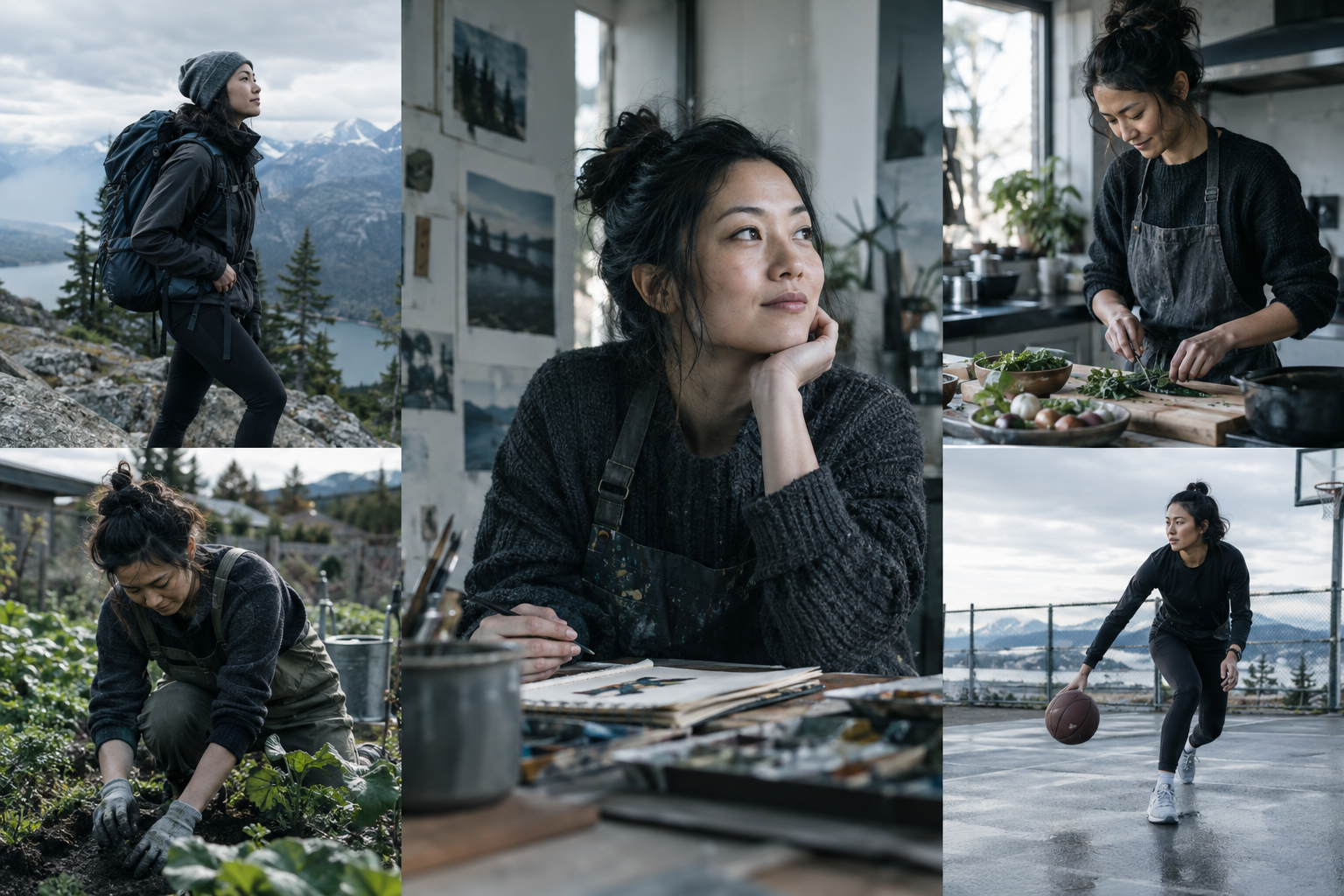
Creative practice does not begin and end in the studio. Many artists have maintained serious interests outside their primary medium, from gardening and cooking to chess, hiking, collecting, and organized sports. These activities were not necessarily side projects or productivity tools. Often, they simply gave the artist another way to pay attention.
That distinction matters. When artist block arrives, there is a temptation to solve it by working harder at the same problem. More hours, more references, more pressure. Yet creative block can be a sign that the practice needs different material: physical movement, practical tasks, social contact, new surroundings, or time without a professional objective.
Artist hobbies can provide those conditions. They diversify attention, interrupt habitual decisions, and build a life that can support creative work over the long term.
Famous artists and their hobbies
The image of the artist wholly consumed by art is culturally persistent but historically incomplete. Many famous artists pursued other interests with commitment, pleasure, or curiosity.
Romare Bearden drew deeply from music, particularly jazz and blues. He wrote songs, formed close relationships with musicians, and helped establish the 306 Group as a space for Black artists and writers. Music and community were not simply references for his collages. They were sustained interests that shaped his sense of rhythm, structure, memory, and collective life.
Carrie Mae Weems has described cooking as an important part of her life and work. The kitchen table became both a gathering place and the setting for her landmark *Kitchen Table Series*. Food, conversation, and hospitality offer forms of making grounded in care and exchange, while the table itself can hold private experience alongside larger questions of race, gender, family, and power.
Mark Bradford’s long-standing interest in basketball offers a different kind of counterpoint to studio practice. The sport brings movement, rules, improvisation, and collective attention into play. These qualities resonate with the physical scale and layered construction of his work without reducing basketball to a source of artistic content.
Alma Thomas was an enthusiastic gardener whose close observation of flowers, leaves, weather, and seasonal change informed her approach to color and pattern. Gardening provided a daily relationship with the natural world as well as a subject she could revisit through abstraction.
Claude Monet was also an accomplished gardener. At Giverny, he shaped the landscape through planting, color, water, and seasonal rhythm. The garden was both an independent passion and, eventually, a central subject of his paintings. Gardening offered a slower form of composition, governed partly by design and partly by forces beyond his control.
Georgia O’Keeffe walked extensively in the landscapes around her homes in New Mexico. She collected bones, stones, and other natural forms, but walking itself also mattered. It placed observation in motion and created distance from the demands of the studio. Her surroundings became familiar through repeated physical experience rather than occasional visual research.
Marcel Duchamp devoted substantial attention to chess, competing in tournaments and writing about the game. Chess was not painting by other means, but it engaged pattern, decision-making, restraint, and strategy. It also offered a structured arena with clear rules, distinct from the ambiguities of art production and reception.
These examples should not be reduced to simple equations. Bearden did not listen to music only to improve his collages, and Bradford does not engage with basketball merely to become more creative. The useful lesson is broader: an artist’s life can contain multiple forms of attention, discipline, community, and pleasure.
Why creative practice benefits from other interests
Diversifying interests creates contrast. Studio work may be solitary, conceptual, sedentary, or open-ended. A hobby can introduce the opposite conditions: teamwork, physical exertion, repetition, sensory immediacy, or a clear finish line.
This contrast can support creative problem-solving. When attention shifts away from a difficult work, the mind continues making connections without the pressure of immediate resolution. Cognitive incubation is one reason ideas often appear during a walk, while cooking, or after exercise rather than at the desk.
Hobbies also protect identity. If every activity is judged through the lens of artistic success, a rejected proposal or difficult exhibition can feel total. Having other interests creates additional sources of competence, community, and satisfaction. That wider foundation is useful for artist wellbeing, particularly in a field shaped by uncertain income and uneven recognition.
The goal is not to optimize every leisure activity. A hobby loses much of its value when it becomes another professional obligation. Its contribution may be indirect and impossible to measure. That is not a weakness.
Using hobbies to work through artist block
Artist block is not a single condition. It can come from exhaustion, fear, repetition, isolation, financial pressure, or an excess of unresolved choices. Before reaching for a solution, it helps to identify what is missing.
If the practice feels mentally crowded, choose an activity that requires the body. If it feels isolated, choose a group activity. If it feels abstract, work with ingredients, soil, fabric, or tools. If it feels chaotic, try an activity with rules and a defined sequence. If it feels overmanaged, choose something playful and unmeasured.
A useful response to artist block is often a change of mode rather than a complete withdrawal from practice. The following activities offer different kinds of contrast.
Hiking and walking for artists
Walking changes pace, scale, and sensory focus. It can move attention from internal critique toward weather, terrain, sound, distance, and the behavior of other people. Hiking adds navigation, endurance, and an encounter with environments that cannot be fully controlled.
Artists do not need to document every walk. In fact, leaving the camera or sketchbook behind can reduce the pressure to extract content. The walk can remain an experience rather than a research trip.
For artists with limited access to rural landscapes, urban walking can be equally useful. Follow a transit route on foot, walk beside a river, visit an unfamiliar neighborhood, or repeat the same route at different times of day. Observation becomes a habit without requiring an immediate artwork.
Organized sports and creative resilience
Organized sports offer something many studio practices do not: a shared objective, regular schedule, and immediate feedback. Football, basketball, tennis, rowing, running clubs, martial arts, or recreational leagues can create contact with people outside the cultural sector.
Team sports also ask participants to respond in real time. There is little opportunity for perfectionism when the game continues regardless of a mistake. That experience can be valuable for artists who have become immobilized by self-editing.
The benefit is not limited to physical fitness. Sports teach pacing, recovery, cooperation, and tolerance for an imperfect performance. They also establish a boundary around studio time. A practice can become more focused when it is not expected to occupy every available hour.
Accessibility matters. Organized movement might mean a walking group, adaptive sport, swimming, yoga, or a low-cost community class. The relevant question is not intensity but whether the activity offers a different relationship to the body and to other people.
Cooking and baking as material practice
Cooking and baking combine process, improvisation, memory, and care. They involve color, texture, temperature, timing, and transformation, but lead to a practical and temporary result. A meal is made to be consumed rather than preserved, exhibited, or assessed by a panel.
Baking can be especially useful when creative work feels formless. Recipes provide constraints and an established order of operations. Cooking, by contrast, can allow more improvisation. Both produce direct sensory feedback and a clear stopping point.
Food also creates social connection. Preparing a meal for others shifts attention from individual authorship toward hospitality. For artists whose practice has become too closely tied to professional visibility, cooking can restore an experience of making that is immediate, useful, and shared.
Gardening, crafts, games, and collecting
Gardening places creative decisions within longer cycles. Plants respond to season, climate, soil, and care, not deadlines alone. Progress is uneven, and control is always partial. This can recalibrate expectations for a creative practice that has become driven by constant output.
Craft hobbies such as knitting, woodworking, ceramics, or repair can restore a direct relationship with materials. Artists working primarily with screens, administration, or conceptual development may find repetitive handwork particularly grounding. It offers tangible evidence of progress without needing to carry major intellectual weight.
Games provide another route. Chess, cards, puzzles, and tabletop games create systems in which choices have consequences. They can refresh an artist’s interest in structure, sequence, and collaboration while remaining separate from studio outcomes.
Collecting encourages close looking and classification. Stamps, records, shells, textiles, printed matter, or everyday objects can form a personal archive. The practice of collecting can sharpen attention, although it does not need to become source material for art.
How to choose a hobby without creating more work
Begin with curiosity rather than personal branding. Choose something you would still want to do if nobody in your professional network knew about it. This protects the activity from becoming content, evidence of productivity, or an extension of the portfolio.
Start at a manageable scale. One weekly class, a monthly hike, or a single new recipe is enough. Artist hobbies should fit within actual constraints of time, money, energy, disability, and care responsibilities.
It can also help to choose an activity in which you are willing to be a beginner. Creative professionals are often accustomed to exercising expertise. Entering a space without mastery can make experimentation feel less threatening and failure less consequential.
Avoid demanding an immediate return. A hobby does not need to generate an idea, improve a project, or become a new revenue stream. Its value may lie in rest, friendship, strength, routine, or simple enjoyment. Those are substantial outcomes in themselves.
Building a sustainable creative practice
A sustainable creative practice is not one that produces continuously. It is one that can absorb uncertainty, change, and periods of limited output without collapsing.
Interests outside art help build that capacity. Hiking can create space. Organized sports can build community and resilience. Cooking and baking can return attention to the senses. Gardening can teach patience. Games can renew strategic thinking. Crafts can reconnect the hand and the mind.
The lives of artists such as Romare Bearden, Carrie Mae Weems, Mark Bradford, and Alma Thomas show that serious artistic commitment does not require a narrow existence. Creative development often depends on experiences that sit beyond the formal boundaries of practice.
When artist block appears, the answer may not be another hour in the studio. It may be a walk, a match, a meal, or an activity with no intended audience. Stepping away from the work is not always abandoning it. Sometimes it is how the practice finds more room to continue.