
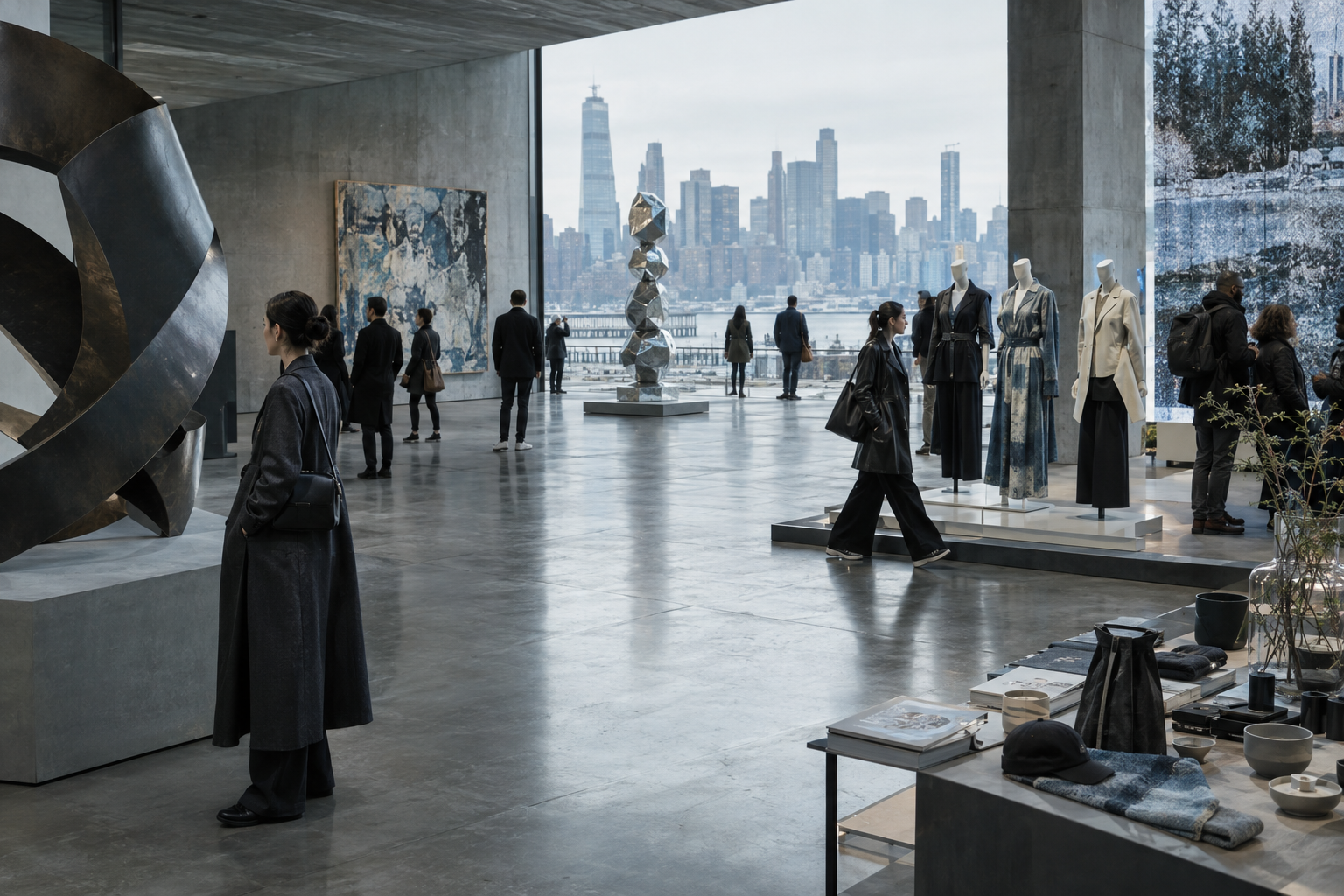
The art market is often described through auction totals, gallery sales, and collector sentiment. Those measures matter, but they no longer describe the full field. Artistic value now moves through fashion collaborations, consumer products, public commissions, property development, digital platforms, cultural tourism, and civic infrastructure. A useful market report must therefore examine not only where art is sold, but where cultural value is created, transferred, and retained.
This report considers the outlook for 2027 through that wider lens. It draws on the historical behavior of the art market, recent collecting studies, public reporting from Art Basel and UBS, and observable changes across adjacent creative sectors. Because complete 2026 and 2027 market totals are not yet available, its forecasts are directional rather than presented as settled facts.
Our central finding is straightforward: the next phase of the creative economy will be shaped less by indiscriminate expansion than by selective investment, stronger operating systems, and pressure for clearer public and commercial value. Organizations that connect cultural purpose to durable infrastructure will be better positioned than those relying on attention alone.
The art market is larger than art sales
The conventional global art market includes auction houses, galleries, dealers, art fairs, advisers, collectors, museums, and artists. Its headline reports typically measure sales, imports and exports, online activity, wealth trends, and collector behavior. This framework offers an important view of liquidity and confidence, but it captures only one part of the cultural economy.
An artist may receive a gallery payment, a fashion licensing fee, a public-art commission, a teaching honorarium, and income from an edition within the same year. A cultural organization may operate exhibitions while also advising developers, producing festivals, managing archives, and delivering community programs. A brand may acquire art, commission packaging, sponsor a biennial, and use an artist's work across global advertising.
Each transaction belongs to a different budget, contract structure, and reporting system. Together, however, they form the artist's market.
This expanded definition changes the strategic question. The issue is not simply whether the art market will rise or fall in 2027. It is how capital, rights, visibility, and public legitimacy will circulate among artists, institutions, businesses, and civic partners.
What recent market evidence tells us
The Art Basel and UBS Global Art Market Report estimated global art sales at $67.8 billion in 2022, up 3 percent year over year, before reporting a 4 percent decline to $65 billion in 2023. In 2024, reported sales fell further to approximately $57.5 billion, a 12 percent contraction by value, while transaction volume increased by 3 percent.
That divergence is significant. It suggests that the market did not simply stop. Instead, activity shifted away from the most expensive transactions. Lower and middle price segments remained comparatively active while high-value sales, which disproportionately affect aggregate totals, became less frequent.
Recent collecting surveys have also pointed to continued engagement among wealthy collectors, alongside greater selectivity, cross-border caution, and interest in new artists and channels. Survey evidence should not be confused with completed transactions, but it remains useful as an indicator of intent.
Several durable art market trends emerge:
- Buyers remain active but require stronger reasons to commit.
- The top end is vulnerable to thin supply and a small number of major consignments.
- Accessible price points can sustain transaction volume during uncertain periods.
- In-person relationships remain important despite normalized digital discovery.
- Estate planning, succession, philanthropy, and museum relationships increasingly shape collector decisions.
- Artists and organizations need multiple revenue channels rather than dependence on one market intermediary.
The broader lesson is that contraction by value does not mean cultural disengagement. It often means capital is moving more carefully and being distributed differently.
Historical cycles reward infrastructure
The art market has always been sensitive to larger economic systems. The Dutch market of the seventeenth century grew alongside trade, finance, and a prosperous merchant class. Nineteenth-century dealer networks helped shift artistic careers away from dependence on academies and royal patronage. The postwar American market expanded with museums, foundations, galleries, magazines, corporate collections, and new concentrations of private wealth.
Later disruptions produced familiar patterns. The early 1990s correction followed speculative excess. The 2008 financial crisis reduced sales but accelerated globalization and professionalization. The pandemic closed physical venues while hastening online viewing rooms, remote transactions, and direct digital communication. The NFT boom briefly promised a reset of ownership and artist compensation, but its contraction showed that technical novelty cannot replace governance, audience trust, or sustained cultural meaning.
Across these periods, durable growth rarely came from a single sales mechanism. It came from an ecosystem: credible criticism, committed collectors, transparent contracts, archives, museums, education, public investment, and businesses capable of supporting artists over time.
This history matters for the art market outlook 2027. Volatile periods tend to expose weak systems. They also create openings for organizations that can integrate strategy, production, distribution, and stewardship.
A principles-based model for the creative economy
A healthy cultural economy should be assessed against more than gross sales. Our model centers on five principles.
Artists are economic actors, not decorative inputs
Artists generate intellectual property, public meaning, social connection, and commercial distinction. Their compensation should reflect the full scope of that contribution. Fees for labor, licensing, fabrication, travel, maintenance, and reuse should be separated and clearly documented.
Cultural value should be retained, not merely extracted
A successful project leaves useful assets behind: income, skills, documentation, audience relationships, physical infrastructure, rights ownership, or institutional capacity. Visibility without retained value is a weak bargain.
Access and excellence are compatible
Public reach does not require diluted standards. The strongest cultural projects combine serious artistic thinking with intelligible routes for participation. Access must be designed into commissioning, location, language, pricing, and programming.
Partnerships require shared accountability
Artist-brand collaborations, public commissions, and civic developments often involve unequal power. Good governance identifies who decides, who carries risk, who owns the work, who maintains it, and how disagreement will be resolved.
End-to-end thinking is a market advantage
A commission does not begin with fabrication or end at launch. Research, artist selection, contracting, community engagement, production, communications, documentation, maintenance, evaluation, and legacy planning are one connected system.
These principles are not separate from market performance. They are increasingly prerequisites for it.
Prediction 1: The middle market will matter more in 2027
The global art market has long depended on trophy works to generate headlines. Yet the recent combination of lower sales values and resilient transaction volumes suggests a broader base of activity below the top end.
In 2027, we expect galleries, fairs, and artist studios to place greater emphasis on works, editions, and programs accessible to a wider collector class. This does not mean a race to lower prices. It means more deliberate price architecture.
Artists and galleries can build coherent ladders across original works, studies, editions, publications, functional objects, and institutional commissions. Each format should retain artistic integrity while serving a distinct audience and economic purpose.
For collectors, this creates entry points based on knowledge rather than only wealth. For artists, it can improve cash flow and reduce dependence on occasional high-value sales. For institutions and brands, it provides opportunities to support acquisition programs that distribute value across a larger group of practitioners.
The risk is overproduction. Editions and products without disciplined quantities, quality control, and audience strategy can weaken both trust and pricing. The opportunity lies in calibrated access, not indiscriminate volume.
Prediction 2: Collector behavior will become more relational
In uncertain markets, buyers tend to favor trusted networks. By 2027, collector engagement will increasingly resemble long-term cultural participation rather than episodic purchasing.
Collectors will expect access to context: studio visits, curatorial interpretation, conservation guidance, collection management, and meaningful institutional relationships. Many will also face questions of succession. What should be retained, donated, sold, or transferred? How should archives and digital records be organized? Which institutions are appropriate partners?
This creates a strategic opening for galleries, advisers, museums, and artist foundations. Services around stewardship may become as important as the initial sale. Collection data, provenance, rights records, conservation histories, and philanthropic intentions should be organized before a transfer becomes urgent.
The next generation of collectors may also define status differently. Cultural participation, local impact, and demonstrable support for artists can carry more meaning than simple accumulation. Organizations that understand this shift will design relationships around learning and contribution, not only access to inventory.
Prediction 3: Fashion will move from collaboration to cultural equity
Fashion has repeatedly used art to renew its symbolic value. Elsa Schiaparelli's work with Salvador Dalí, Yves Saint Laurent's Mondrian dresses, Keith Haring's commercial projects, Louis Vuitton's artist collaborations, and contemporary partnerships across luxury and streetwear all demonstrate the long history of exchange.
The model has also produced recurring problems: compressed timelines, unclear authorship, limited artist compensation, culturally insensitive imagery, and campaigns that borrow credibility without supporting the communities from which it comes.
By 2027, leading fashion and art partnerships should move beyond the capsule collection. We expect stronger agreements around licensing duration, territories, approvals, attribution, archival use, resale, and digital reproduction. Artists will seek participation in the value they help create, not only a one-time fee.
What we would like to see is cultural equity built into fashion partnerships. That could include acquisition of the artist's work, support for a studio or community organization, paid research periods, museum loans, education programs, and transparent reporting on economic outcomes.
Fashion companies should also distinguish between commissioning an image and entering a cultural partnership. The latter requires curatorial research, internal education, appropriate production standards, and a legacy beyond the campaign cycle.
Prediction 4: Artist-designed consumer products will mature
Consumer products can broaden access to an artist's ideas and create recurring revenue. They can also reduce complex practices to logos. The difference lies in product strategy.
Museum shops and artist editions have long occupied this territory, from Bauhaus objects and artist books to twentieth-century design multiples. More recently, direct-to-consumer platforms and global manufacturing have lowered barriers to production. But low barriers can create high waste.
In 2027, the strongest artist consumer products will begin with a clear proposition: why should this work exist as an object, who is it for, how will it be made, and what value returns to the artist? Product categories should be selected for conceptual and practical fit rather than trend compliance.
Brands and cultural organizations need realistic unit economics. The artist fee, royalty, sampling, manufacturing, packaging, freight, duties, wholesale margin, retail margin, returns, and unsold inventory must be modeled before launch. Sustainability claims should be tied to materials, labor, logistics, repair, and end-of-life planning.
We expect growth in smaller, better-made runs; regional manufacturing; collectible functional objects; and products connected to exhibitions, archives, or public programs. Success will be measured through margin and sell-through, but also through new audiences, repeat engagement, and rights retained by the artist.
Prediction 5: Public art will be treated as infrastructure
Public art is too often commissioned late in a development process, after architecture, landscape, access, utilities, and community priorities have been fixed. The artist is then asked to animate a predetermined site.
This approach limits both artistic ambition and public value. It can also generate avoidable costs when engineering, permissions, maintenance, and community concerns are addressed too late.
The better model treats artists as contributors to civic infrastructure from the beginning. Artists can inform wayfinding, public space, ecological interpretation, lighting, memory, mobility, and the social use of a site. Their role may result in an object, but it may also produce a program, landscape intervention, digital layer, or long-term community platform.
By 2027, public art strategy will increasingly be evaluated through lifecycle performance. Commissioners will ask:
- Was the artist involved early enough to influence the site?
- Was the community paid or otherwise supported for its contribution?
- Are fabrication and maintenance budgets realistic?
- Who owns the work and associated intellectual property?
- How will accessibility and public safety be addressed?
- What happens if the site is redeveloped?
- Is there a deaccession or relocation process?
The public artwork is not complete at installation. Inspection, conservation, interpretation, programming, and data management are part of the commission.
Prediction 6: Civic development will require cultural value plans
Cities increasingly use culture to attract residents, visitors, employers, and investment. Cultural districts, creative workspaces, festivals, and public art can support this work. They can also contribute to displacement when cultural identity is used to market areas without protecting the people who produced it.
In 2027, responsible civic development should move beyond generalized claims about placemaking. Major developments should adopt cultural value plans with measurable commitments.
These may include affordable artist workspace, local commissioning targets, apprenticeships, operating support for cultural organizations, community governance, preservation of significant sites, and long-term public programming. Contributions should be tied to development timelines and protected from later budget reductions.
Historical experience offers a warning. Artists have often made neglected districts culturally visible, only to be priced out as land values rise. End-to-end civic thinking must connect cultural investment to housing, transportation, land use, procurement, and small-business policy.
The strongest civic partnerships will not ask culture to solve structural problems alone. They will position cultural strategy alongside the economic and regulatory tools that shape a place.
Prediction 7: Brands will demand evidence, but measurement must improve
Corporate cultural spending is entering a more accountable phase. Marketing teams want reach, engagement, press, and customer acquisition. Sustainability and social-impact teams want credible outcomes. Artists and curators want the work to retain complexity.
These interests can coexist, but only if success is defined before production.
In 2027, cultural partnerships will use mixed measurement frameworks. Commercial indicators may include sales, qualified leads, footfall, content performance, brand perception, and customer retention. Cultural indicators may include artist income, new commissions, acquisitions, audience diversity, critical response, skills transferred, and the longevity of partnerships.
Not every benefit should be reduced to an immediate financial return. A museum partnership and a product launch operate on different timelines. The purpose of measurement is to make decisions and improve practice, not manufacture certainty.
We would like to see brands publish more complete accounts of cultural spending: how much reached artists, how partners were selected, what rights were acquired, and what remained after the campaign. Transparency would improve trust and help the sector establish more credible benchmarks.
Prediction 8: Artificial intelligence will make provenance more important
Artificial intelligence is changing image production, research, administration, marketing, and audience interaction. Its most consequential effect on the art market may be increased demand for verifiable origin.
As synthetic media becomes commonplace, collectors and institutions will place greater value on documentation: who made a work, when, with which tools, under what permissions, and through what chain of custody. Artist estates and studios will need stronger systems for cataloguing physical and digital works.
By 2027, AI clauses should be standard in many cultural contracts. These clauses may address training data, image ingestion, style imitation, digital replicas, promotional use, and the creation of derivative assets. Consent cannot be assumed from the delivery of a high-resolution file.
AI will also reduce administrative burdens when applied carefully. Studios can use it to organize archives, draft routine documentation, model budgets, and support accessibility. Human review remains essential, particularly where cultural interpretation, rights, attribution, or sensitive community histories are involved.
The strategic divide will not be between organizations that use AI and those that do not. It will be between those with clear governance and those without it.
Prediction 9: Artist estates will become a growth sector
The transfer of wealth and cultural property between generations is creating new demands around artist estates. An estate is not simply an inventory of objects. It may include copyrights, archives, unfinished works, correspondence, digital files, fabrication instructions, moral rights, property, and institutional relationships.
Poor planning can lead to disputes, market confusion, lost records, and damaged reputations. Strong planning can support scholarship, exhibitions, licensing, conservation, and long-term income.
In 2027, more living artists will begin estate planning earlier. They will define authentication processes, organize records, clarify rights, and identify appropriate stewards. Galleries and advisers will need to understand that market development after an artist's death requires restraint. Releasing too much work, licensing indiscriminately, or manufacturing scarcity can undermine long-term value.
Museums, universities, and archives may become important partners, but they cannot absorb every estate. New shared-service models are likely to emerge for storage, digitization, rights administration, conservation, and research access.
Prediction 10: Regional ecosystems will gain influence
The global art market remains concentrated in a small number of cities, fairs, and auction centers. Yet high operating costs, geopolitical tension, and digital access are strengthening regional networks.
By 2027, more artists and organizations will build careers through connected local ecosystems rather than immediate relocation to a traditional capital. Regional museums, universities, residencies, public-art programs, collectors, and businesses can together provide meaningful infrastructure.
This is not an argument for isolation. International exchange remains essential. The opportunity is to create two-way movement so that regional culture is not treated merely as raw material for larger markets.
Civic partners can support this by coordinating grants, procurement, workspace, tourism, education, and transport. Brands can contribute through multi-year commissioning rather than short-term discovery campaigns. Collectors can strengthen regional markets by buying consistently and lending locally.
A healthy regional ecosystem allows artists to develop on their own terms while remaining connected to wider cultural and commercial circuits.
Building an end-to-end cultural strategy
The organizations best prepared for 2027 will connect mission, capital, operations, and evaluation. An end-to-end cultural strategy can be organized into eight stages.
1. Define the purpose
Clarify whether the project exists to generate artist income, build a collection, improve public space, reach customers, support community memory, or achieve several goals. Rank those goals rather than treating all outcomes as equal.
2. Map the ecosystem
Identify artists, residents, institutions, fabricators, funders, agencies, developers, and public authorities. Understand where power, knowledge, and risk sit.
3. Design governance
Set decision rights, advisory roles, approval processes, conflict policies, and community participation. Governance should be proportionate but explicit.
4. Build the financial model
Separate creative fees from production costs. Include contingency, insurance, documentation, accessibility, maintenance, evaluation, and staff time. Determine who carries overruns and inventory risk.
5. Protect rights
Specify ownership, licensing, attribution, exclusivity, image use, AI use, merchandising, archival access, and termination. Rights should match the actual project, not a universal template.
6. Deliver with care
Coordinate curation, production, compliance, fabrication, communications, and community engagement. Protect time for artist review and iteration.
7. Measure the right outcomes
Combine financial, cultural, social, and operational indicators. Establish baselines and reporting responsibilities before launch.
8. Plan the legacy
Decide what will remain: a maintained artwork, archive, publication, audience relationship, local skill, revenue stream, or repeatable partnership model.
This process may appear slower than campaign-led commissioning. In practice, it reduces expensive corrections and increases the chance that cultural value will endure.
Risks to the 2027 outlook
The art market outlook 2027 remains exposed to interest rates, wealth concentration, currency movements, trade policy, conflict, and changing tax rules. Public cultural budgets may face further pressure. Galleries and nonprofit organizations continue to manage high staffing, rent, shipping, and insurance costs.
Climate disruption is also becoming an operating issue. Fairs, touring exhibitions, storage facilities, and public artworks face physical and financial risks. Insurance exclusions and transport costs may reshape where and how work circulates.
There is also a trust risk. Audiences are increasingly alert to extractive partnerships, unsupported sustainability claims, and symbolic community engagement. Cultural organizations cannot lend legitimacy indefinitely without examining the conditions attached to sponsorship and development.
These pressures favor clear priorities. Not every institution needs global expansion. Not every artist needs a product line. Not every brand needs an art collaboration. Strategic refusal can preserve capital and credibility.
What we would like to see in 2027
A stronger creative economy would direct a larger share of project budgets to artists and cultural workers. It would publish clearer fee standards and normalize separate payment for concept development, licensing, production oversight, and public participation.
Fashion partnerships would build long-term cultural equity rather than borrowing artistic relevance for a season. Consumer products would be fewer, better, and grounded in responsible production. Public art would be planned as civic infrastructure with funded maintenance. Developers would commit to cultural value plans that survive changes in ownership and market conditions.
Collectors would support research, conservation, and institutions alongside acquisition. Museums would improve artist compensation where possible and collaborate on shared infrastructure. Technology companies would seek consent before using cultural material to train commercial systems. Artist estates would receive support before a crisis of succession.
Most importantly, organizations would stop treating mission and commercial discipline as opposites. Financial clarity can protect artistic ambition. Good contracts can support trust. Measurement can strengthen public accountability. Operational competence can create room for risk.
Closing: from market recovery to market design
The defining question for 2027 is not whether the art market returns to a previous peak. Aggregate growth may recover while underlying conditions remain fragile. A better measure is whether the creative economy becomes more capable of sustaining artists, institutions, and communities through cycles.
The evidence points toward a more selective and distributed market. Collectors will still buy, but relationships and stewardship will matter more. Brands will still seek cultural distinction, but scrutiny of rights and outcomes will increase. Cities will still use culture in development, but public expectations for accountability will become harder to ignore.
For artists and cultural organizations, resilience will come from diversified income, organized rights, strong documentation, and partnerships aligned with purpose. For brands and civic partners, credibility will depend on early engagement, fair compensation, transparent governance, and long-term care.
The opportunity is not simply to predict the next market. It is to design better conditions for cultural work: systems in which value is recognized, shared, and retained by the people who create it.